
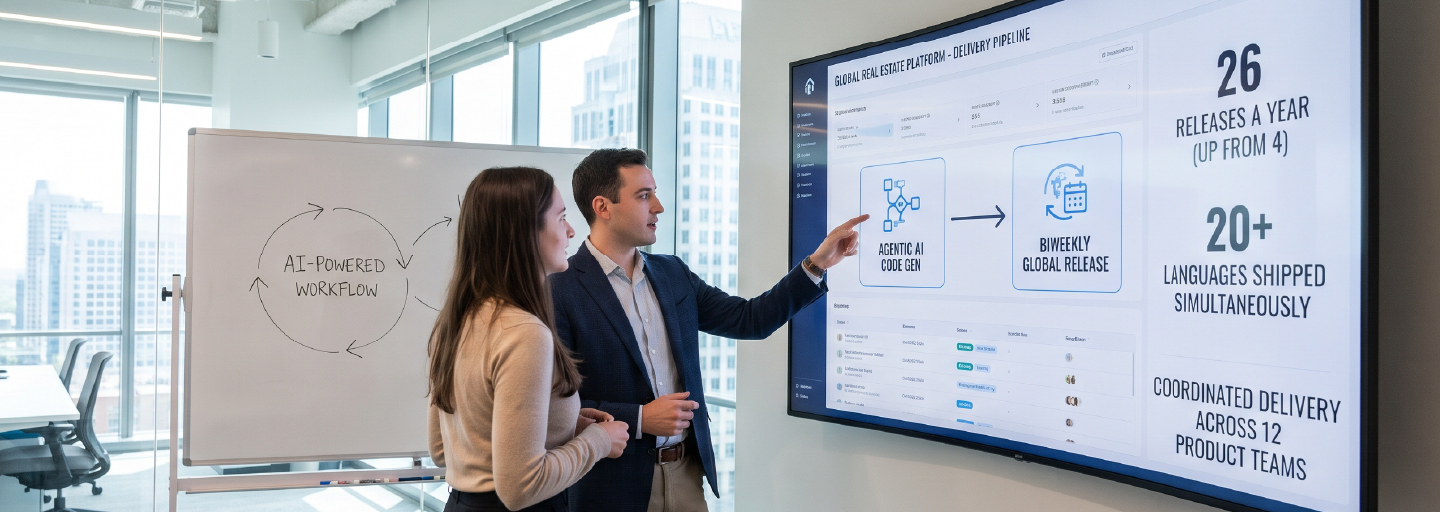
How a real estate firm scaled agentic AI across 10+ product teams and increased release delivery by 550%
Hitachi Digital helped this firm transform how it develops and delivers digital products with agentic AI, accelerating releases from quarterly to biweekly reducing delivery effort by an estimated 41%, and enabling simultaneous releases across 20+ languages.
Challenge
A real estate firm saw agentic AI as a way to continuously evolve its global product portfolio and bring new capabilities to customers faster.
But its existing delivery model stood in the way: releases happened quarterly, AI adoption was developing independently across teams without shared governance or verification standards, and annual localization cycles could leave non-English markets as much as a year behind.
Simply adding more teams would have increased capacity and cost without addressing these underlying constraints.
To accelerate delivery without sacrificing quality, the team partnered with Hitachi Digital to adapt its operating model to create a faster, more consistent way to develop, verify and release products across teams and markets with agentic AI.
Is your product roadmap moving faster than your release cycle? See how Hitachi Digital helps close the gap.
Value Created
The firm engaged Hitachi Digital to replace fragmented development practices with a shared engineering model for continuous AI-enabled delivery across more than 10 product teams. The new approach standardized how teams develop, verify, measure and release AI-enabled products through:
One shared specification
Requirements, code generation and testing work from the same shared specification, which stays current throughout development.
Built-in verification
Automated checks and human approval are built into the delivery pipeline, so AI-generated code is verified before it ships.
Ongoing measurement of AI adoption
A recurring assessment tracks adoption and impact while identifying issues such as inconsistent prompting, fragmented tools and code-generation errors.
Simultaneous localization
Translation happens as part of the biweekly release process, using shared terminology and human review to bring each release to 20+ languages at the same time.
Together, these practices established a unified engineering model across 10+ product teams, with 96% to 98% adoption in daily work, creating a repeatable foundation for continuous AI-enabled delivery.
Our shared engineering model for continuous AI-enabled delivery
| Category | Before | After |
|---|---|---|
| Release cycles | Quarterly — 4× annually | Biweekly — 26 annually |
| Engineering model | Siloed, independent adoption across teams and markets | Unified across 10+ product teams, with 96–98% adoption in daily work |
| Verification | Inconsistent AI verification processes | Automated checks and human approvals built in as a precondition to release |
| Governance | No shared governance or standards | Common standards and ongoing measurement of AI adoption and impact |
| Global delivery and translation | Delayed up to 1 year in non-English markets | Simultaneous localization across 20+ languages |
Impact
The firm now ships at a cadence its product commitments require, with AI governed consistently across the portfolio. Key results include:
- Quarterly to biweekly releases at enterprise scale, with an estimated 41% less effort in the delivery lifecycle
- 20+ languages shipped simultaneously in every release, closing a year-long lag between English and non-English customers and retiring an annual translation cycle
- Three weeks from vision to a working agentic prototype, lowering the cost of testing and enabling a wider consideration set
- About $330,000 in annualized run cost removed on a single team, with the same practice now running across 10+ teams
With a repeatable delivery model in place, each release builds on an established process rather than requiring teams to renegotiate how the work gets done. As a result, product teams can deliver faster and more frequently, continuously evolving products across markets at scale.